
21:9 / 4:5 mobile
Credits : D.Maugendre – Inventaire Patrimoine - Région Occitanie
01
The site and its history
A century and a half of thermalism


Credits : postcard, Éric Sentucq collection / Labouche brothers; phototype; photograph, Jeremy Chamot-Rossi.
The waters of Ginoles have been analyzed regularly since 1763 and awarded medals since 1776. The first bathhouse was built shortly after 1808 , following a notarial act settling water rights with the inhabitants of the village.
The development of the resort is the work of two families: Guillaume Joseph Martin , from 1842, then Prosper Lassave , from 1871. It was under their impetus that the Hôtel des Tilleuls (1845), the Galerie des Bains (1878), the Hôtel Sainte-Eulalie (1881), the Villa du Lac (1880) and the Chalet du Roc (1912) were built.
At its peak, between the two World Wars, the spa welcomed nearly a thousand spa-goers and their companions each season. The waters—bicarbonate, calcium, and magnesium-rich—were prescribed for ailments of the kidneys, bladder, intestines, and liver, as well as for rheumatism. They were consumed in baths, as drinks, and in bottles. In 1879 , the Royal Academy of Sciences, Inscriptions and Belles-Lettres of Toulouse awarded them a silver medal; in 1907 , the Bouisson-Bertrand Institute of Montpellier conducted the formal chemical analysis.
The thermal spa activity ceased in 1958.
After the thermal baths
The site then went through several lives: leisure centre with hotel-restaurant from 1962, holiday camp of the Citroën works council from 1970, residence then discotheque until 1992. Then came the decline: collapsed roofs, condemned floors, half a century of sleep.
The memory of the place, however, has survived. The handwritten memoirs of Octavie Lassave and the family correspondence, preserved by the Allevy family, are now deposited in the Aude Departmental Archives.

Credits: Philippe Allevy Collection. Deposited at the Aude Departmental Archives, catalogued in progress.
The buildings today
Building condition — August 2026
Building
Construction
State
Grand Hôtel du Parc ( Hôtel des Tilleuls)
1845
Roof partially collapsed, floors condemned
Hotel Sainte-Eulalie
1881 (core ~1808)
Roof partially collapsed, floors condemned
Bathing gallery ( 16 cabins, 24 bathtubs)
1878
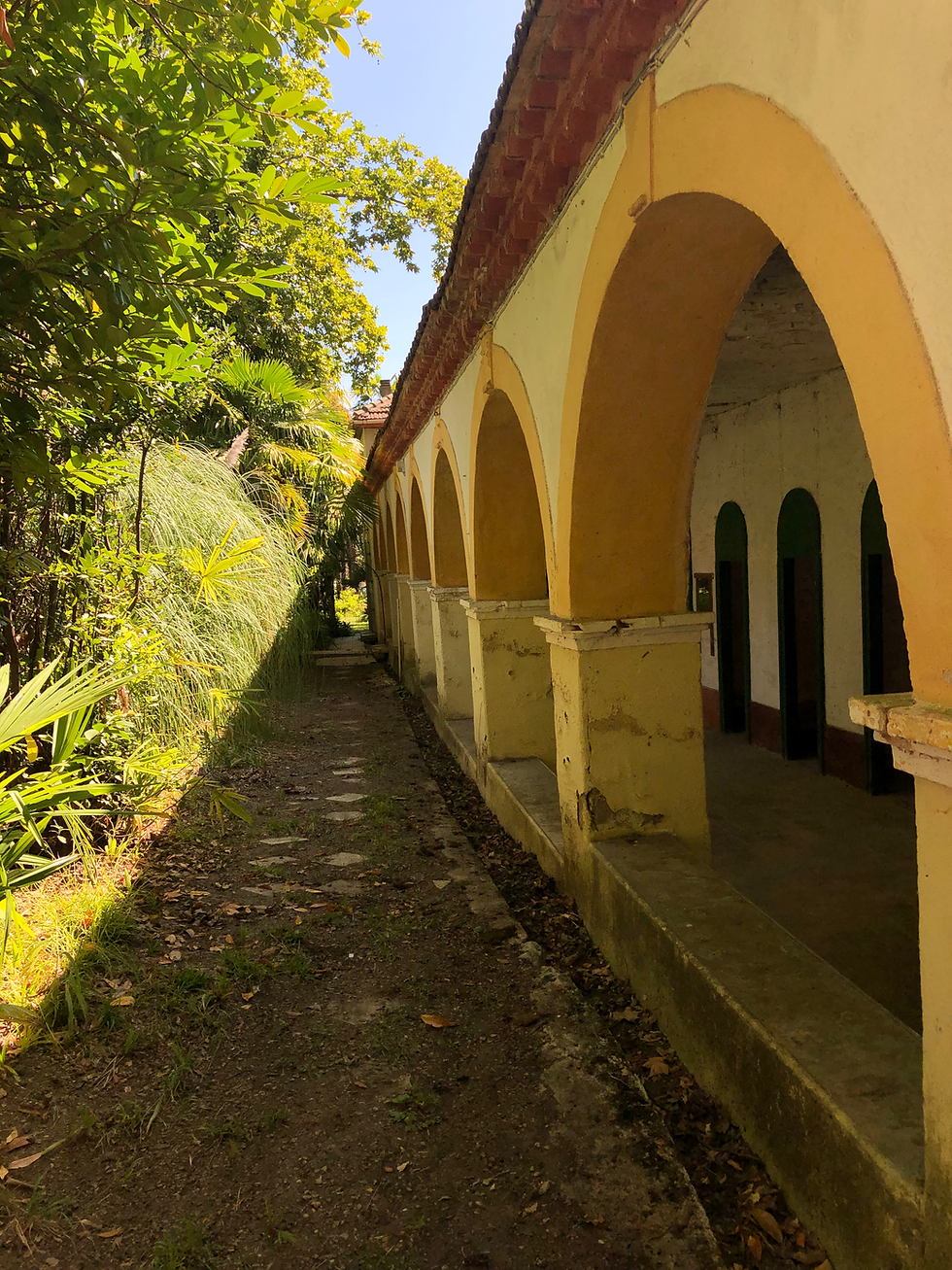
West pavilion collapsed; arcades overlooking the park preserved
Lake Villa "L'Oasis" ( former mill )
mill since 1826
villa 1880
Access condemned, first restoration planned
Spring Pavilion ( refreshment stand )
~1840–1868
Closed; water is still flowing through the park
Saint Roch Chapel
~1868–1871
No roof, access prohibited, property of the municipality of Quillan
Park, pond, plane tree avenue, palm grove
aisle 1804
palm grove ~1845
The park is alive; public access is closed
.jpg)

.jpg)


.jpg)
credits: D.Maugendre – Inventaire Patrimoine - Région Occitanie 2026.
02
The three SPRINGS
The waters are still flowing
.jpeg)
.jpg)
Before/after pair #2.
Three springs feed the site. Two formed the station; the third remained a curiosity.
The Pascal spring
16 l/s · 24 °C · historic refreshment stand
People used to come here to drink the water; its overflow fed the park's pond.
Flow rate and temperature according to the General Inventory of Occitanie. The 1902 bather's guide gives different figures — the sources of the time already disputed the degrees.
The Sainte-Eulalie spring
18 l/s · 28 °C · baths and drinking
It filled the bathtubs in the bathing gallery. A notarial act dated January 4, 1808, refers to it as the "fountain of sorrows" — the fountain where people came to lay down their ailments.
The icy spring
0 °C · in all seasons · never exploited
Described in the 1902 bather's guide: a spring whose water remains at 0°C in all seasons and never freezes, even in the harshest winters. Never exploited, never forgotten.
The waters still flow. They irrigate the park, fill the ponds, and wait.
03
The project
Reviving the station
.jpg)
Credits : D.Maugendre – Inventaire Patrimoine - Région Occitanie
The thermal spa of Ginoles-les-Bains is now owned by the Quality of Life World Foundation , a Belgian public utility foundation, which is undertaking its complete restoration.
The project is simple to state and long to do: restore the buildings, reopen the park, and return the place to its primary function — to welcome.
Restore in stages
Each building is put back into use before the next one is started. The first stage is the lake villa — “The Oasis”.
Restored by the people
Participatory projects, artisan residencies, and cultural events are part of the method, not decoration. A place restored by a thousand hands belongs to its region in a different way than a place delivered by a developer.
Restore to last
The legal structure of the estate guarantees that the restored site cannot be sold off piecemeal or used for purposes other than hosting. Details are available in our bylaws, which can be consulted upon request.
The Baths Gallery, future exhibition space
The 1878 gallery — sixteen cabins, twenty-four bathtubs, and a series of semicircular arches opening onto the park — will become the site's exhibition and reception area.
Its open structure, covered but not closed, allows this use in accordance with the flood risk prevention plan: the restoration will focus on the roof and consolidation, preserving the original character.
3:2
Credits : D.Maugendre – Inventaire Patrimoine - Région Occitanie
_HEIC.png)
04
Life returns
The Oasis —
first restoration


Crédits: carte postale, fonds Éric Sentucq / Phototypie Labouche frères ; photographie : D.Maugendre – Inventaire Patrimoine - Région Occitanie; dessin : Enrico Guiguilé, architecte, 2025.
The estate's former mill—which became a villa in 1880 and a dance hall in the 1970s—will be the first building to be restored. The project, designed by architect Enrico Guiguilé , preserves the 19th-century stone structure and the top of a contemporary wooden roof.
The plan: a brasserie opening onto the park, a professional kitchen designed for workshops, an adjoining vegetable garden, and a flexible upper floor for various uses. The goal: to give the village back a place for interaction — a table, a bar, seasonal offerings.
Work planned for 2027 · Operator: announcement to follow
The park
The preliminary design for the restoration of the thermal park have been drawn up by a landscape architect: the avenue of plane trees dating from 1804, the palm grove, the pools, and a promenade redesigned in sequences—the Path of Memories, the Esplanade of the Spring, the lower gardens near the Coulent stream. The preliminary design work will continue this autumn.
.jpg)
Credits : T&C collective 2020
05
How does it work?
The restoration relies on three formats, combined
Participatory construction projects
Supervised workshops where volunteers and heritage professionals work together — traditional masonry, carpentry, stone carving. The first project will take place in the summer of 2027 ; a partnership with a national network of volunteer workcamps is currently being discussed.
Residencies and workshops
Craftsmen, landscapers, cooks, artists: the site will host working stays as soon as the first spaces allow.
Cultural events
Concerts, exhibitions, village festivals in the park — the place is also being revitalized by being inhabited. The site's journal will report on it.

16:9
Credits : T&C collective 2024
06
Participate
Three doors, depending on what you're here for.
Volunteers
Want to participate in a work camp—a week or a summer, hands-on with stonework, professionally supervised? Leave your address: you'll be the first to know when registration opens for summer 2027.
Building with us
You want to stay longer than just a construction site — craftspeople, makers, future residents, those who want to contribute to shaping what a place like this becomes. Write to us; tell us what you can do.
or write to contact@ginoles-les-bains.fr
Project leaders
You have a project—and the means to carry it out—that is looking for a space: workshop, production, reception, cultural. The estate has spaces that can be reactivated. We are reviewing expressions of interest as they come in.
Institutions, press, partners: partners@ginoles-les-bains.fr
07
Who is leading the project?
A public benefit foundation
The estate is owned by the Quality of Life World Foundation, a Belgian public utility foundation (company number 0747751224), recognized by royal decree.
Board of Directors:
Pim Ampe (Constitutional Director)
Joeri Torfs (Operations Director).
The operational management of the estate is ensured by a dedicated asset management company, registered with the RCS of Carcassonne (full name in the legal notices ).
Institutional contact: partners@ginoles-les-bains.fr
08
Documents and archives
The project is based on a real documentary collection: Aude departmental archives, Philippe Allevy collection, Inventory of the heritage of Occitanie, Gallica, and the Sentucq and Labouche private collections.
None of this belongs to the Foundation. We cite it, we credit it, and we refer back to it. The collection is open to researchers, students, and journalists.
09
JOURNAL
Month after month
May 19, 2025
The Oasis redesigned
Architect Enrico Guiguilé has submitted a study for the restoration of the old mill: brewery, workshop kitchen, vegetable garden. The project preserves the 19th-century stone structure and the top of a contemporary wooden roof.
August 2026
The site opens
ginoles-les-bains.fr is online. It will document, month by month, the restoration of the resort
2025
The parks masterplan
First landscape design sketch for the restoration of the thermal park: the avenue of plane trees dating from 1804, the palm grove, the pools, and a promenade redesigned in sequences. The preliminary project continues.
→
Summer 2027
The first participatory construction project will open its registration next year.
A week or a summer, hands-on stonework, professional guidance. Leave your address: you'll be the first to know.
Institutions, press, partners: partners@ginoles-les-bains.fr